

Astronomers have announced a breakthrough involving a miniature binary star system exoplanets discovery, revealing three Earth-sized worlds orbiting two red dwarf stars. This rare configuration challenges long-standing theories about how planets form in complex gravitational environments.
This finding adds to the growing catalog of more than 6,100 confirmed exoplanets. Yet few are as extraordinary as the system known as TOI-2267.

👉 Explore more discoveries in our Space Science Section on PukaarPakistan.
H2: A Strange New System of Miniature Binary Star System Exoplanets
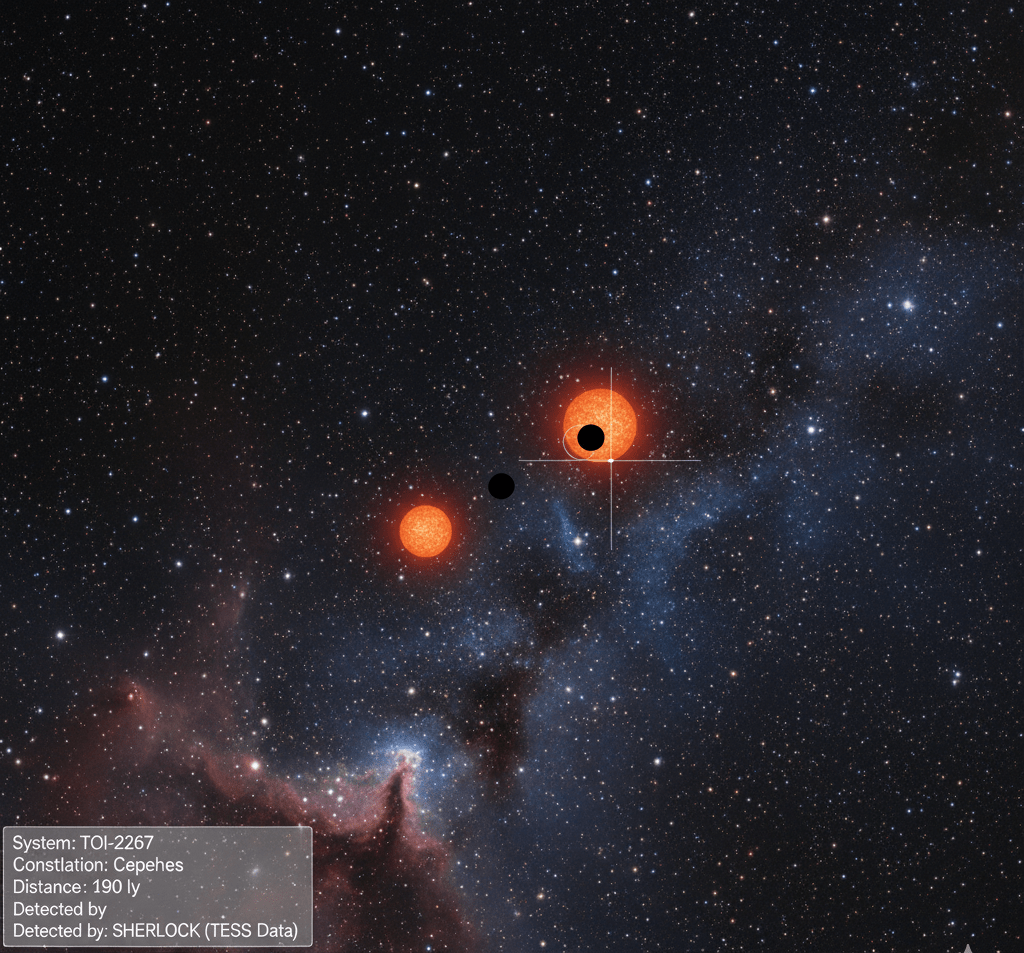
Researchers from the University of Liège announced their results in the study titled “Two Warm Earth-sized Planets and an Earth-sized Candidate in the Binary System TOI-2267.”
These planets were detected using SHERLOCK, a specialized detection program that scans data from NASA’s TESS (Transiting Exoplanet Survey Satellite) mission.
Sebastián Zúñiga-Fernández explained that their internal algorithm uncovered planets missed by TESS — an extremely rare situation where both stars in a binary system host transiting planets.
The system sits 190 light-years away, located in the constellation Cepheus, where two small M-type red dwarf stars orbit each other at a distance of 8 AU.
For more astronomy insights, check out our Astronomy Updates.
H2: Orbital Dance of the Three New Exoplanets
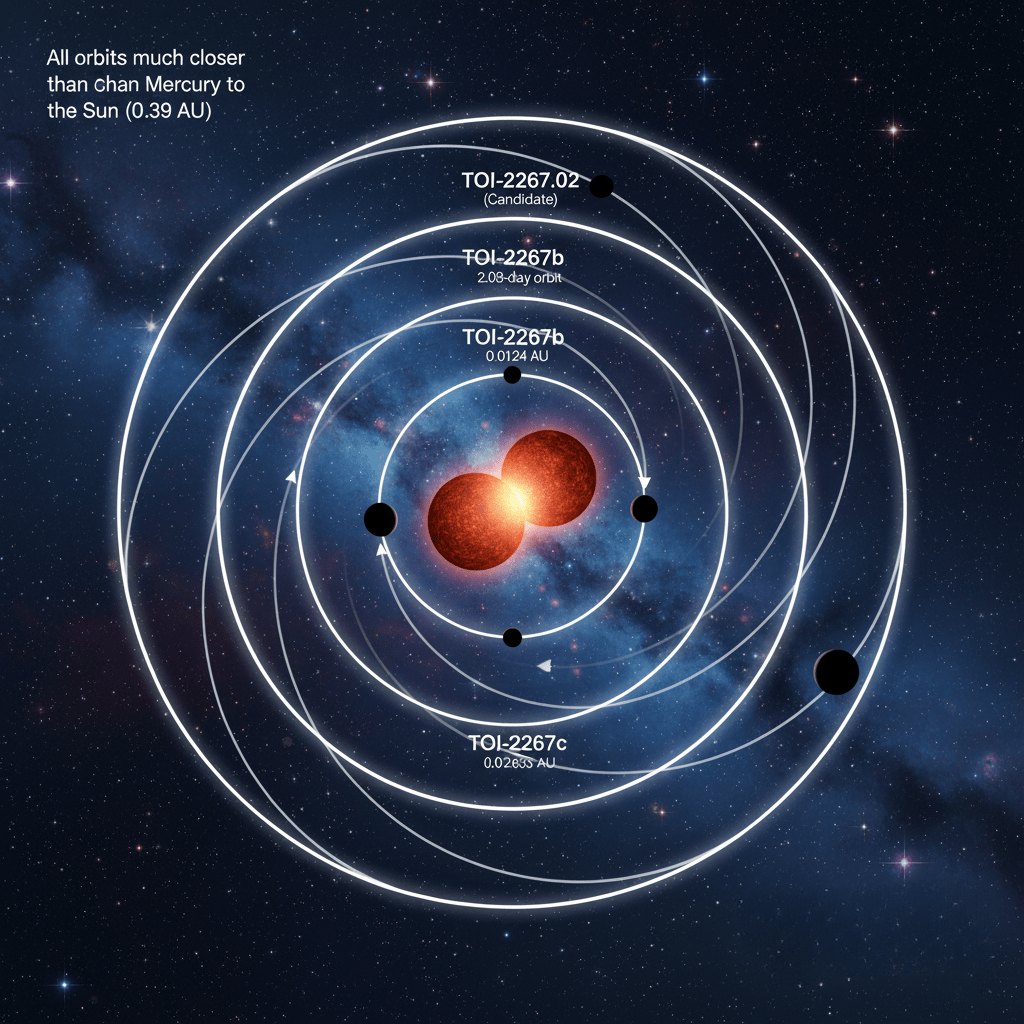
The TOI-2267 system includes two confirmed planets and one candidate:
- TOI-2267b
- 2.28-day orbit
- 0.0205 AU distance
- TOI-2267c
- 3.49-day orbit
- 0.0263 AU distance
- TOI-2267.02 (candidate)
- 2.03-day orbit
- 0.0124 AU distance
These planets orbit extremely close to their stars — closer than Mercury orbits the Sun.
This stability challenges predictions from the three-body problem, which suggests binary systems should be unstable.
H2: Why This Miniature Binary Star System Exoplanets Discovery Matters
H3: A Unique Planetary Architecture
TOI-2267 is the first known binary system where each star has its own transiting planet.
This suggests planets may form more easily in these environments than previously believed.
H3: Tools Behind the Discovery
Instruments and programs involved include:
- SHERLOCK pipeline
- TRAPPIST telescopes
- SPECULOOS network
- NASA TESS mission
Researchers now plan to use the James Webb Space Telescope (JWST) and large ground-based telescopes such as Gran Telescopio Canarias (GTC) to deepen the study of these planets.
H2: What This Means for the Future of Exoplanet Exploration
This discovery widens our understanding of how diverse planetary systems can be across the universe.
Even though our planet orbits a solitary star, systems like TOI-2267 show that multi-star planetary systems might be common.
To explore more stories about our cosmic neighborhood, visit PukaarPakistan – Space Science.
Conclusion: A New Chapter in Exoplanet Discovery
The confirmation of three Earth-sized planets within a miniature binary star system marks a significant milestone in planetary science. It reshapes theories of formation and highlights the creativity of nature in crafting worlds.