






JWST Spots Universe’s First Stars, Revealing Galaxy Origins
Astronomers using the powerful James Webb Space Telescope first stars may have identified the universe’s very first generation of stars. This extraordinary observation of a distant, ancient cluster could finally confirm the existence of the long-theorized Population III stars and completely reshape our current understanding of how galaxies emerged after the Big Bang. This discovery is essentially a cosmic time capsule.

LAP1-B: A Glimpse of Primordial Stars
We may have had a glimpse of the first group of stars formed by the universe, thanks to the James Webb Space Telescope (JWST). Astronomers spotted this incredibly distant cluster of stars, known as LAP1-B, a staggering 13 billion light-years away. This makes it one of the earliest objects we have ever observed.
A report published in The Astrophysical Journal Letters detailed the cluster’s characteristics. The data showed that LAP1-B matches the predicted profile of Population III stars. Scientists theorize that these objects formed shortly after the Big Bang, approximately 13.8 billion years ago, from the pristine, primordial mixture of hydrogen and helium gas. For more details on this cosmic event, check out our article on the early moments of the universe.
The Enigma of Population III Stars
What made these stars so unique? Population III stars are sometimes called “dark stars.” Scientists propose they were colossal giants, potentially thousands of times heavier and millions of times brighter than our Sun. They would have appeared even before heavier elements (known as metals to astronomers) existed in the universe.
Eli Visbal, the lead author of the research, confirmed that the LAP1-B cluster’s spectra showed strong emission lines of high-energy photons. This is a tell-tale sign of Population III stars. Moreover, the astronomers suggest the LAP1-B stars are about 100 times the weight of the Sun. This finding aligns perfectly with long-standing theoretical predictions. If you are interested in the tools astronomers use, read our guide on advanced space telescope technology.
Einstein’s Theory and the Cosmic Magnifying Glass
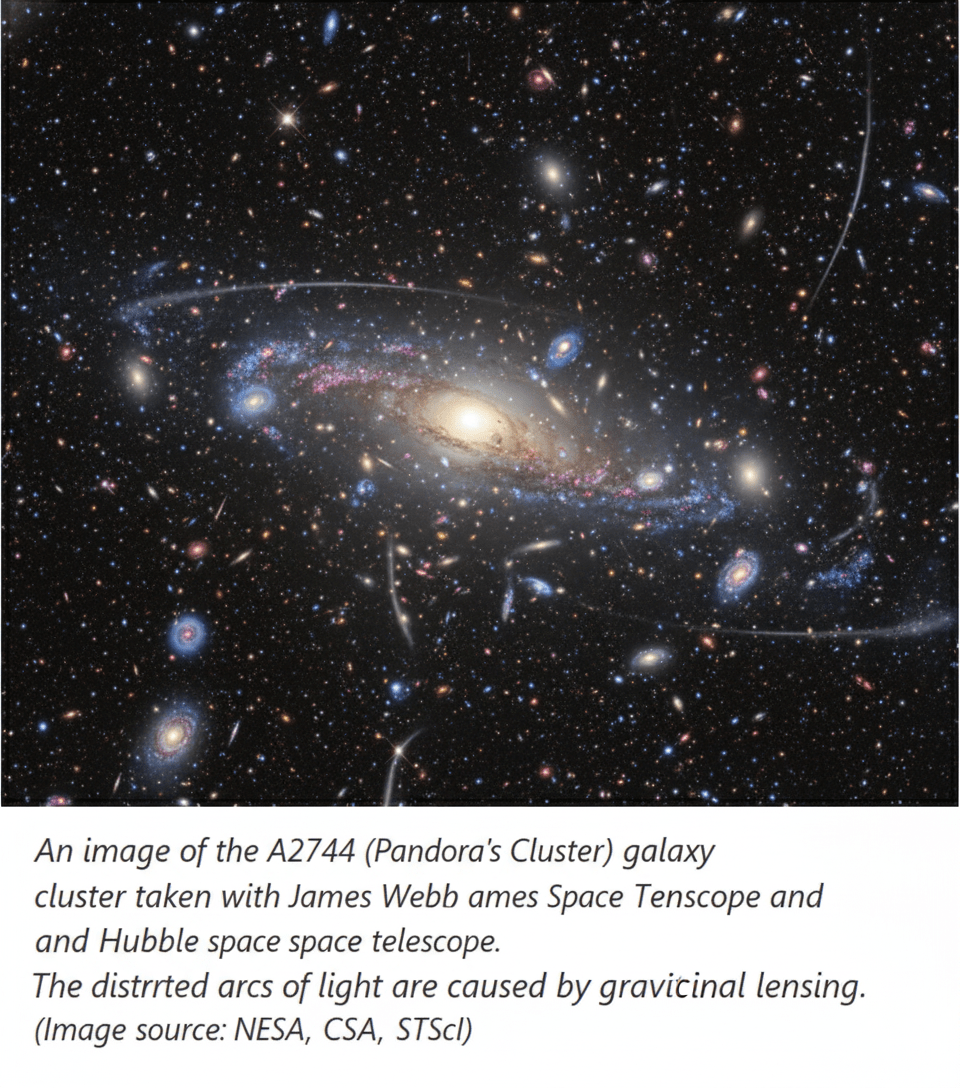
This incredible discovery would not have been possible without the work of Albert Einstein. The famous genius postulated the phenomenon of gravitational lensing. This occurs because massive objects, like galaxy clusters, bend the fabric of space-time. Consequently, they act like a huge cosmic magnifying glass, amplifying the light from objects directly behind them.
In this instance, a massive galaxy cluster named MACS J0416 bent and magnified LAP1-B’s light. This effectively boosted the ancient, faint light and threw it directly into JWST’s path, allowing the telescope to capture its signal. Learn more about the underlying concepts in our piece on the theory of relativity in modern astronomy.
Unlocking the Secrets of Galaxy Formation
The scientists noted that LAP1-B appears to satisfy all three necessary conditions to be identified as the universe’s first stars:
- It was formed in an environment with low-metallicity (lacking heavy elements) hydrogen-helium gas.
- It possesses a low-mass cluster harbouring a few massive stars.
- Its stellar distribution matches the expected initial mass function (the distribution of star masses at the time the cluster formed).
More analysis is definitely required to validate these initial findings. However, if confirmed, LAP1-B would represent the very first detection of these long-sought primordial stars. This major discovery will significantly expand our knowledge of how galaxies formed from ancient dark matter structures. You can explore a related topic in our deep dive on understanding dark matter. Read more about the technology behind these findings on PukaarPakistan (Science & Technology).
Conclusion and Next Steps
The James Webb Space Telescope continues to push the boundaries of our understanding of the cosmos. The potential detection of the James Webb Space Telescope first stars is a landmark moment in astronomy. It provides a direct window into the universe’s infancy.
What do you think about this monumental discovery? The confirmation of Population III stars would dramatically change our textbooks on cosmology. To keep up with all the latest cosmic news, don’t miss our weekly Pakistan astronomy news roundup. Share your thoughts in the comments below!